
Chord Finder — Audio Chord Detector & Piano Identifier
Extract timestamped chord progressions from any song across 84 harmonic templates, or click keys on a 2-octave interactive piano to reverse-identify chord names, slash inversions, and voicings—with zero uploads.
Ready · Drop any song to extract clickable chord cards, or switch to the 2-Octave Piano tab to name custom voicings.
C – G – Am – F
Recognizes Major, Minor, 7, Maj7, Min7, Sus4, and Dim across all 12 roots in 1s or 2s slices, with instant plain-text .txt chord sheet export.
Click any chord card above to jump playback straight to that bar, or export the timestamped progression below.
C Major · Root position
Character: Bright, stable & resolved
0 uploads — audio transcription & piano synthesis run locally in RAM. Click chord cards to audition exact timestamps or reverse-identify slash inversions offline. See chord formula table & privacy proof ↓
ACT I · HARMONIC TEMPLATE ENGINE
How Audio Chord Extraction & Reverse Piano Naming Work
Working out harmony by ear or identifying an unfamiliar chord shape on a keyboard normally requires switching between transcription software and theory calculators. AIAC unifies both workflows inside a single browser-local instrument.
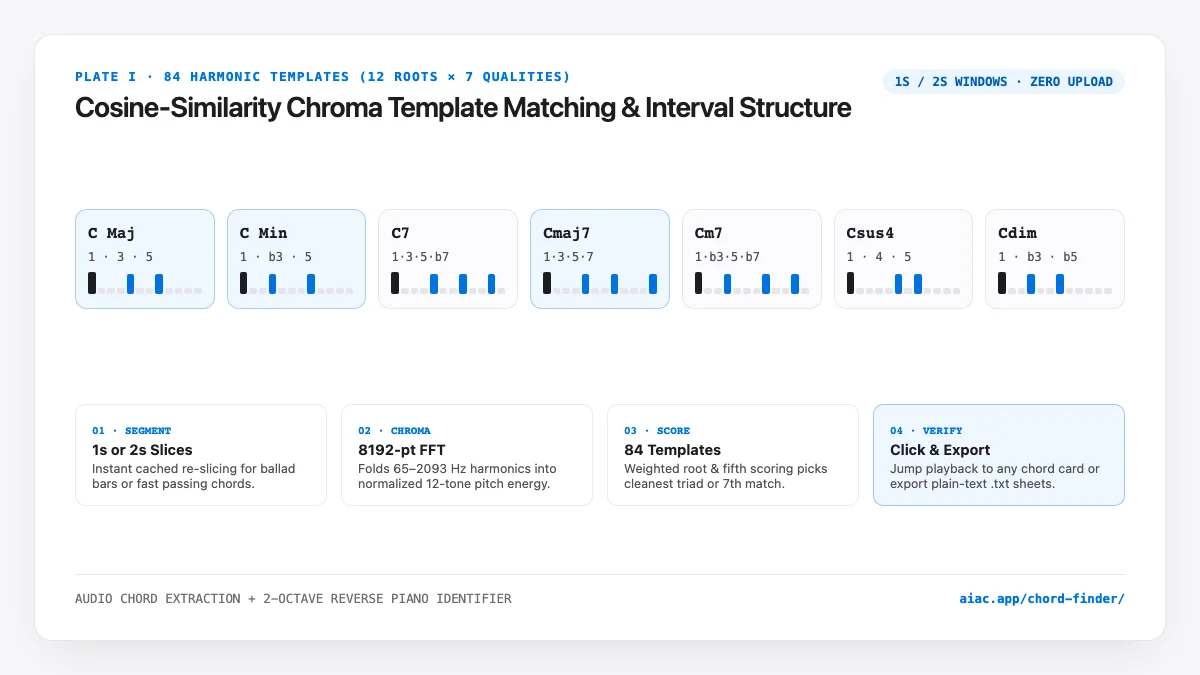
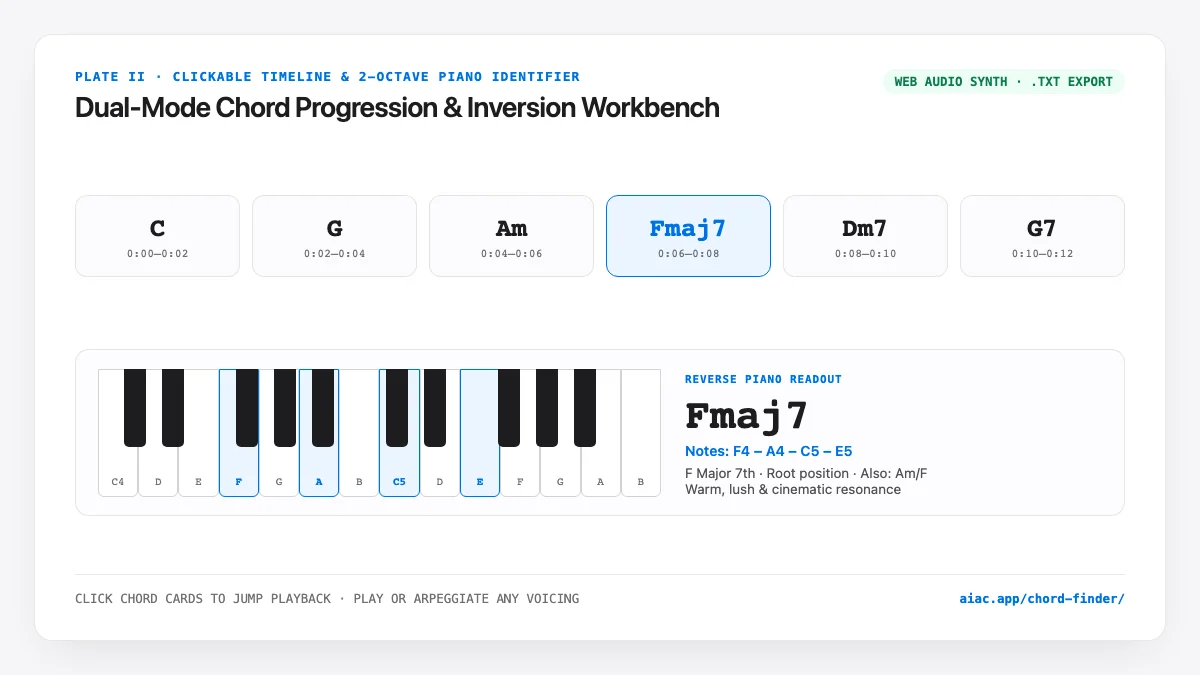
In Audio Detector mode, your track is sliced into 1-second or 2-second windows, analyzed through an 8192-point FFT chromagram with sub-semitone interpolation, and scored via weighted cosine similarity against 84 harmonic templates (12 roots × 7 qualities: Major, Minor, 7, Maj7, Min7, Sus4, and Dim). In 2-Octave Piano mode, clicking any keys across C4–B5 instantly resolves root notes, extended intervals, and slash-bass inversions (such as C/E or Am/E) with built-in Web Audio synthesis.
Score(r, q) = ( Chroma₁₂ · Template(r, q) ) / ( ‖Chroma₁₂‖ · ‖Template‖ )
12 roots × 7 audio qualities (84 templates) · 16+ piano voicing qualities & slash inversions · 0 soundfont downloads
ACT II · CHORD QUALITIES & PROGRESSION ARCHETYPES
Common Songwriting Chord Progressions & Voicings
Most pop, jazz, rock, and acoustic songs revolve around six harmonic archetypes. Click any card below to jump directly into Audio Chord Detection or the 2-Octave Interactive Piano.
ACT III · TWO MODES, ONE WORKBENCH
Choosing Between 1s vs 2s Windows & Piano Reverse Lookup
Audio chord transcription always balances time resolution against harmonic stability. A 2-second window averages enough sustain to suppress drum transients on pop, folk, and acoustic ballads; a 1-second window captures rapid jazz turnarounds and passing bass changes. Switching between 1s and 2s re-analyzes your cached RAM buffer in milliseconds.
When a dense chorus masks a subtle voicing, switch straight to the 2-Octave Piano tab, click the notes you hear, and hit Play Chord or Arpeggiate to confirm the exact inversion and harmonic mood.
INTERACTIVE WORKBENCH SHORTCUTS
Jump directly to the right mode in the dual-tab instrument above:
ACT IV · CHORD FORMULAS & ACCURACY BOUNDARIES
Supported Chord Qualities & Detection Reference
Review the exact interval formulas matched across Audio Chord Detection and Interactive Piano Reverse Identification by opening the reference drawers below.
Click Any Card to Jump
Every detected chord card binds to its exact start timestamp in the embedded player, highlighting live as your track plays.
100% Client-Side RAM
Songwriting demos, band recordings, and copyrighted practice tracks never leave your browser—verify 0 uploaded bytes in DevTools.
Lead Vocals & Heavy Distortion
Clean harmonic mixes (piano, guitar, synths) yield sharpest matches. If loud vocals mask chords, attenuate center vocals in AI Vocal Remover first.
| Chord Quality | Interval Formula | Example (Root C) | Supported Modes |
|---|---|---|---|
| Major Triad | 1 – 3 – 5 | C (C–E–G) | Audio Detector & Piano Finder |
| Minor Triad | 1 – ♭3 – 5 | Cm (C–E♭–G) | Audio Detector & Piano Finder |
| Dominant 7th | 1 – 3 – 5 – ♭7 | C7 (C–E–G–B♭) | Audio Detector & Piano Finder |
| Major 7th | 1 – 3 – 5 – 7 | Cmaj7 (C–E–G–B) | Audio Detector & Piano Finder |
| Minor 7th | 1 – ♭3 – 5 – ♭7 | Cm7 (C–E♭–G–B♭) | Audio Detector & Piano Finder |
| Suspended 4th | 1 – 4 – 5 | Csus4 (C–F–G) | Audio Detector & Piano Finder |
| Diminished Triad | 1 – ♭3 – ♭5 | Cdim (C–E♭–G♭) | Audio Detector & Piano Finder |
| Extended & Slash Inversions | sus2, aug, dim7, m7b5, 6, m6, add9, 5 | C/E, Cadd9, Bm7b5 | 2-Octave Interactive Piano Finder |
| Musical Material | Recommended Window | Pre-Processing Tip |
|---|---|---|
| Pop, Folk & Acoustic Ballads | 2s Window | One chord per bar aligns cleanly; click cards to confirm chorus changes |
| Jazz, Bossa Nova & Fast Passing Chords | 1s Window | Captures rapid ii–V turnarounds instantaneously from cached audio |
| Vocal-Heavy Studio Mixes | 2s Window | Run through AI Vocal Remover first to isolate guitar/piano accompaniment |
| Mystery MIDI / Keyboard Voicings | 2-Octave Piano Tab | Click lowest bass note first to read exact slash inversion (e.g., C/E) |
Verifiable Zero-Upload Privacy & Instant Sheet Export
Original songwriting memos, rehearsal stems, and commercial songs you're transcribing stay strictly inside your browser tab. Both 8192-point FFT chord scoring and Web Audio piano synthesis execute locally in RAM with zero external soundfont requests—letting you copy or save .txt chord sheets even while offline.
Practical Learning, Arranging & Band Rehearsal Workflows
Map out verse and chorus changes without manually scrubbing waveforms, name mysterious keyboard voicings in real time, and export clean chord sheets to share with bandmates. Pair chord extraction with our Song Key & BPM Finder to lock overall key and tempo, clean vocals first in AI Vocal Remover, or arrange full stems inside SoundCraft Online DAW.
ACT V · QUESTIONS & STUDIO INDEX
Frequently Asked Questions
Which chord types does the audio chord detector recognize?
The audio timeline detector matches 84 harmonic templates across all 12 roots: Major, Minor, Dominant 7th (7), Major 7th (maj7), Minor 7th (m7), Suspended 4th (sus4), and Diminished (dim). The interactive 2-octave piano tab also recognizes sus2, aug, dim7, m7b5, 6th, m6, add9, power chords, and slash inversions.
Should I use the 1-second or 2-second segmentation window?
Start with 2s for pop, acoustic ballads, and mid-tempo songs where chords change roughly every bar. Switch to 1s for faster jazz progressions or passing chords—switching windows re-analyzes your cached audio buffer instantaneously without re-decoding.
Can I hear chords directly from the interactive piano finder?
Yes. Clicking any white or black key triggers a built-in Web Audio synthesizer note immediately, and the Play Chord and Arpeggiate buttons sound all selected notes together or sequentially with zero external soundfont downloads.
How does clicking a detected chord card work?
Each detected chord card is linked to its exact start timestamp in the embedded audio player. Clicking a card jumps playback directly to that chord and highlights cards in sync as playback progresses so you can verify changes by ear before exporting.
Is my audio file uploaded to the cloud during chord detection?
No. Both audio chord timeline extraction and 2-octave piano reverse identification run 100% locally inside your browser tab without creating an account or transmitting audio bytes over the network.
How can I improve accuracy on songs with loud lead vocals?
Vocals with heavy vibrato or reverb can occasionally pull chroma bins toward melody notes instead of backing harmony. Run your track through AIAC's browser-local AI Vocal Remover first to isolate the instrumental, then drop the backing track here for cleaner chord extraction.
What format does the exported chord sheet use?
You can copy the progression directly to your clipboard or download a clean plain-text (.txt) file listing the track name, unique chords used, and exact MM:SS start–end timestamps alongside every chord symbol and full name.
Companion Browser-Local Audio Tools
- Song Key & BPM Finder Detect overall musical key, Camelot mixing code, BPM tempo, and clickable 12-note chroma energy. →
- AI Vocal Remover (HTDemucs v4) Isolate backing guitar and piano accompaniment locally for even cleaner chord transcription. →
- Online LUFS Loudness Meter Check ITU-R BS.1770-4 Integrated LUFS and 4× True Peak before releasing acoustic demos or mixes. →
- SoundCraft Online DAW Pure Rust WebAssembly multitrack DAW with MIDI piano roll, built-in synths, and lossless bounce. →