
Song Key & BPM Finder Online
Detect the musical key, Camelot Wheel code, relative major/minor, and BPM tempo of any track locally via an 8192-point FFT chromagram and built-in Web Audio metronome—with zero server uploads.
Ready · Explore a genre reference tab or drop any song to detect its key, Camelot code, and BPM locally.
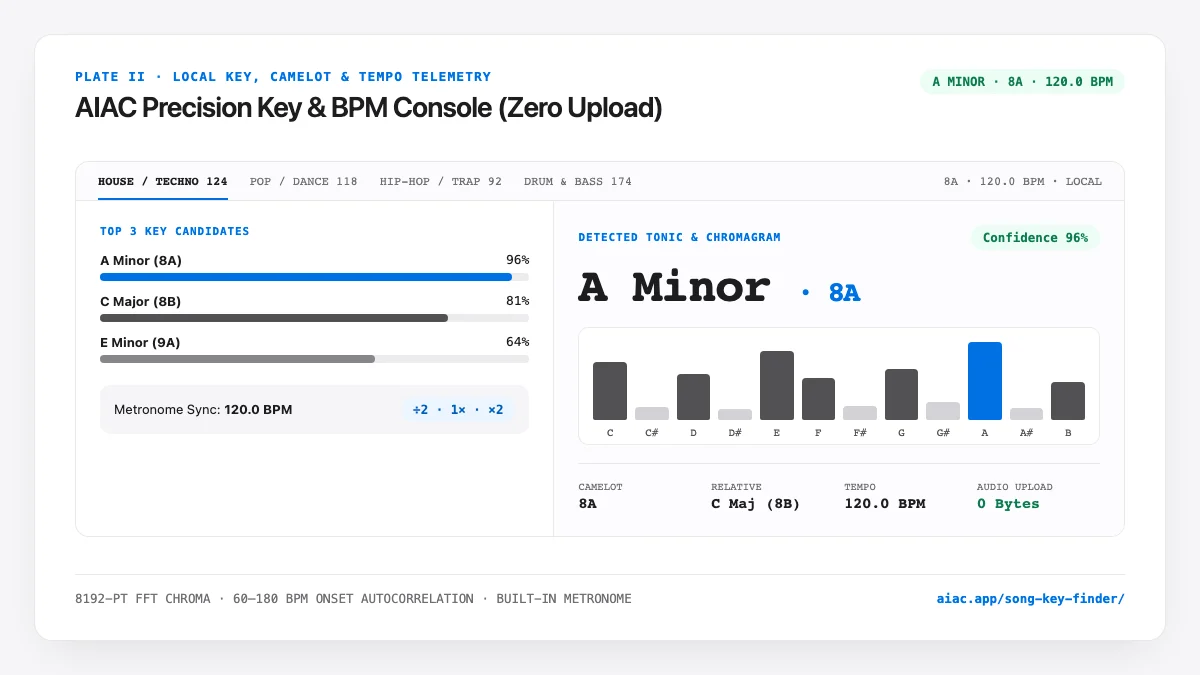
A Minor · 8A
Club house and melodic techno live between 120–128 BPM. From 8A (A Minor), mix cleanly into 8A, 8B (C Major), 9A (E Minor), or 7A (D Minor).
Top 3 Key Candidates (Krumhansl-Schmuckler Correlation)
12-Pitch-Class Chromagram Energy (Click Any Note to Hear)
Want the full bar-by-bar chord progression alongside key and tempo? Extract clickable chord timelines locally.
Open Chord Finder →0 uploads — unreleased beats and DJ stems stay in your tab. 8192-point FFT chromagram extraction, tempo autocorrelation, and metronome audio execute strictly in browser RAM. See Camelot Wheel & privacy proof ↓
ACT I · TONAL & RHYTHMIC DSP
How Krumhansl-Schmuckler Key & BPM Detection Works
Locking Auto-Tune to the exact scale, beat-matching a club transition, or flipping an instrumental sample requires two trustworthy measurements: the track's tonal center and its tempo in BPM. AIAC computes both locally in JavaScript with zero server round-trips.
For pitch analysis, an 8192-point FFT folds harmonic spectral energy across 65 Hz–2093 Hz (C2–C7) into a normalized 12-bin Pitch Class Profile (C through B), then calculates Pearson correlation against all 24 major and minor Krumhansl-Schmuckler key profiles—ranking the Top 3 candidates and relative key pair. Simultaneously, a rectified RMS onset flux envelope runs through lag autocorrelation across 60–180 BPM with parabolic peak interpolation.
r(k) = corr( Chroma₁₂, Rotate_k( Profile_Maj/Min ) ) · BPM = 60 / τ_peak
8192-pt FFT · 65–2093 Hz harmonic fold · 24-key Pearson scoring · 60–180 BPM autocorrelation + ÷2/×2 metronome
ACT II · TEMPO LANDSCAPE & GENRE PROFILES
Music Genre BPM & Harmonic Mixing Scale
Tempo ranges cluster predictably across modern production styles—and half-time genres frequently alias at 2× or ÷2. Click any genre profile below to load its typical BPM and Camelot context into the stage above.
ACT III · HARMONIC MIXING SYSTEM
How DJs Use the Camelot Wheel for Clash-Free Sets
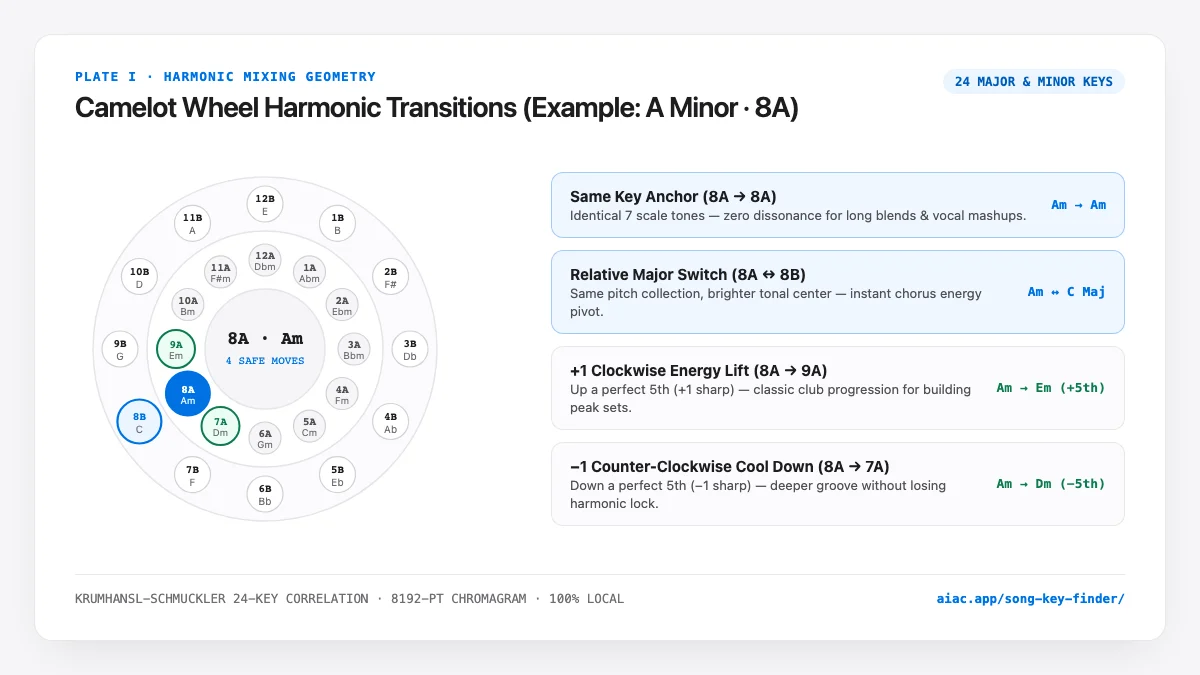
The Camelot Wheel translates the traditional Circle of Fifths into 24 intuitive clock codes: 1A–12A for minor keys and 1B–12B for major keys. Adjacent numbers differ by only a single sharp or flat (six out of seven notes shared), guaranteeing smooth harmonic blends even during long 32-bar EQ transitions.
Start on the detected code shown in the console—for example 8A (A Minor)—then pick your next track from four safe harmonic moves: hold 8A for mashups, pivot to 8B (C Major) for an instant bright mood shift, climb to 9A (E Minor) for subtle dancefloor lift, or drop to 7A (D Minor) for deeper late-night tension.
INTERACTIVE GENRE & TEMPO INDEX
Select a production context below to jump straight back to the key & BPM console above:
ACT IV · COMPLETE CAMELOT TABLE & SCOPE
Camelot Wheel Reference & Detection Boundaries
Every key, Camelot code, and BPM calculation runs strictly in browser memory via Web Audio API and deterministic JavaScript FFT. Expand the exact reference drawers below for the complete 24-key Camelot Wheel chart and DJ harmonic move guide.
Top 3 Keys + Audible Chroma
Instead of a black-box guess, inspect Top 3 correlation scores and click any of the 12 pitch bars to play its reference note against your song.
Verify 0 Bytes in DevTools
Unreleased beats, client vocals, and promo edits never touch an upload queue. Confirm 0 outbound audio bytes in Chrome DevTools → Network.
Variable Tempo & Key Changes
Best for steady-tempo studio mixes and DJ tracks. Live acoustic performances with drifting tempo or mid-song key modulations show dominant average BPM and secondary key in Top 3.
| Camelot Move | Example (from 8A · A Minor) | Musical Relationship | Mixing Effect |
|---|---|---|---|
| Same Code (8A → 8A) | A Minor → A Minor | Identical 7 scale notes | Seamless vocal mashups, acapellas, and long 32-bar blends |
| Relative Switch (8A ↔ 8B) | A Minor ↔ C Major | Relative major / minor | Instant emotional shift between moody minor and bright major |
| +1 Clockwise (8A → 9A) | A Minor → E Minor | Up a perfect 5th (+1♯) | Subtle energy lift across peak-hour club progressions |
| −1 Counter-Clockwise (8A → 7A) | A Minor → D Minor | Down a perfect 5th (−1♯) | Smooth cooldown or deeper hypnotic groove transition |
| +2 Energy Boost (8A → 10A) | A Minor → B Minor | Whole-tone jump (+2 semitones) | High-impact hands-in-the-air peak lift on drop cutovers |
| Clock # | Minor Key (Inner A) | Major Key (Outer B) | Key Signature |
|---|---|---|---|
| 1 | 1A — G♯ / A♭ Minor | 1B — B Major | 5♯ / 7♭ |
| 2 | 2A — D♯ / E♭ Minor | 2B — F♯ / G♭ Major | 6♯ / 6♭ |
| 3 | 3A — B♭ Minor | 3B — D♭ Major | 5♭ |
| 4 | 4A — F Minor | 4B — A♭ Major | 4♭ |
| 5 | 5A — C Minor | 5B — E♭ Major | 3♭ |
| 6 | 6A — G Minor | 6B — B♭ Major | 2♭ |
| 7 | 7A — D Minor | 7B — F Major | 1♭ |
| 8 | 8A — A Minor | 8B — C Major | 0♯ / 0♭ |
| 9 | 9A — E Minor | 9B — G Major | 1♯ |
| 10 | 10A — B Minor | 10B — D Major | 2♯ |
| 11 | 11A — F♯ Minor | 11B — A Major | 3♯ |
| 12 | 12A — C♯ Minor | 12B — E Major | 4♯ |
Verifiable Zero-Upload Privacy & Local Metronome
Client vocal stems, unreleased demos, and promo DJ records stay strictly inside your browser tab. Decoding, 8192-point FFT chromagram folding, beat autocorrelation, the synthesized Web Audio click track, and 1200×675 PNG report export run 100% in local RAM—no accounts, no rate limits, and offline-ready after page load.
Practical DJ, Vocal Production & Remix Workflows
Lock pitch-correction scales before tracking lead vocals, batch-check Camelot numbers for harmonic club transitions, or verify exact beatgrids before dropping stems into SoundCraft Online DAW. Need bar-by-bar chord names for a track? Open our Audio Chord Detector & Interactive Piano, or remove center vocals first in AI Vocal Remover.
ACT V · QUESTIONS & STUDIO INDEX
Frequently Asked Questions
How accurately can a browser detect the musical key of a song?
By computing an 8192-point FFT chromagram across pitch classes C through B (65–2093 Hz) and correlating it against the 24 Krumhansl-Schmuckler major and minor tonal profiles, AIAC reliably detects tonal centers for pop, electronic, rock, acoustic, and hip-hop tracks while displaying the Top 3 candidates and relative key.
What is the Camelot Wheel code shown next to the key?
The Camelot Wheel maps all 24 major and minor keys to intuitive clock codes (1A–12A for minor, 1B–12B for major) used by DJs for harmonic mixing. Tracks sharing the same code, relative pair (A↔B), or ±1 step blend smoothly without harmonic clashes.
Why does BPM sometimes read half-time or double-time?
Genres like trap, drum & bass, dubstep, and halftime ballads carry strong rhythmic pulses at both 70 BPM and 140 BPM (or 87 and 174 BPM). Click Half (÷2) or Double (×2) alongside the built-in Web Audio metronome to confirm the true groove immediately.
Do my unreleased beats or DJ stems get uploaded to any server?
No. Audio decoding, 8192-point FFT chromagram analysis, tempo autocorrelation, metronome synthesis, and PNG report export run 100% locally in browser RAM. Open Chrome DevTools → Network to verify 0 audio bytes leave your device.
What if my track changes key midway or uses non-standard tuning?
Songs that modulate between sections display the dominant key first and the secondary tonal center inside the Top 3 candidate bars. Clicking individual bars in the 12-note chromagram plays that exact reference pitch so you can confirm the tonic by ear.
Can I detect key and BPM from an MP4 video or voice memo?
Yes. Drop MP3, WAV, FLAC, M4A, OGG, or MP4 video files directly onto the stage—your browser extracts the audio track locally via Web Audio API without uploading the video file.
How do I also find the exact chord progression of a song?
Once you know the overall key and tempo here, open AIAC's companion Chord Finder (/chord-finder/) to extract timestamped Major, Minor, 7th, Maj7, Min7, Sus4, and Dim chord cards synced to playback.
Companion Browser-Local Audio Tools
- Audio Chord Detector & Piano Finder Extract timestamped chord progressions from songs and reverse-identify voicings on a 2-octave piano. →
- Online LUFS Loudness Meter EBU Tech 3341 calibrated ITU-R BS.1770-4 LUFS, LRA & 4× FIR True Peak meter for streaming delivery. →
- AI Vocal Remover (HTDemucs v4) Separate lead vocals and instrumentals locally in your browser to create practice backing tracks. →
- SoundCraft Online DAW Pure Rust WebAssembly multitrack studio with 25+ DSP plugins, MIDI piano roll, and lossless bounce. →