
Online LUFS Loudness Meter
Measure ITU-R BS.1770-4 Integrated LUFS, LRA, and 48-tap 4× True Peak directly inside your browser against Spotify, YouTube, Apple Music, Podcast, and EBU R128 standards—with zero server uploads.
Ready · Select a target tab or drop any audio/video file to measure locally.
-14.0 LUFS
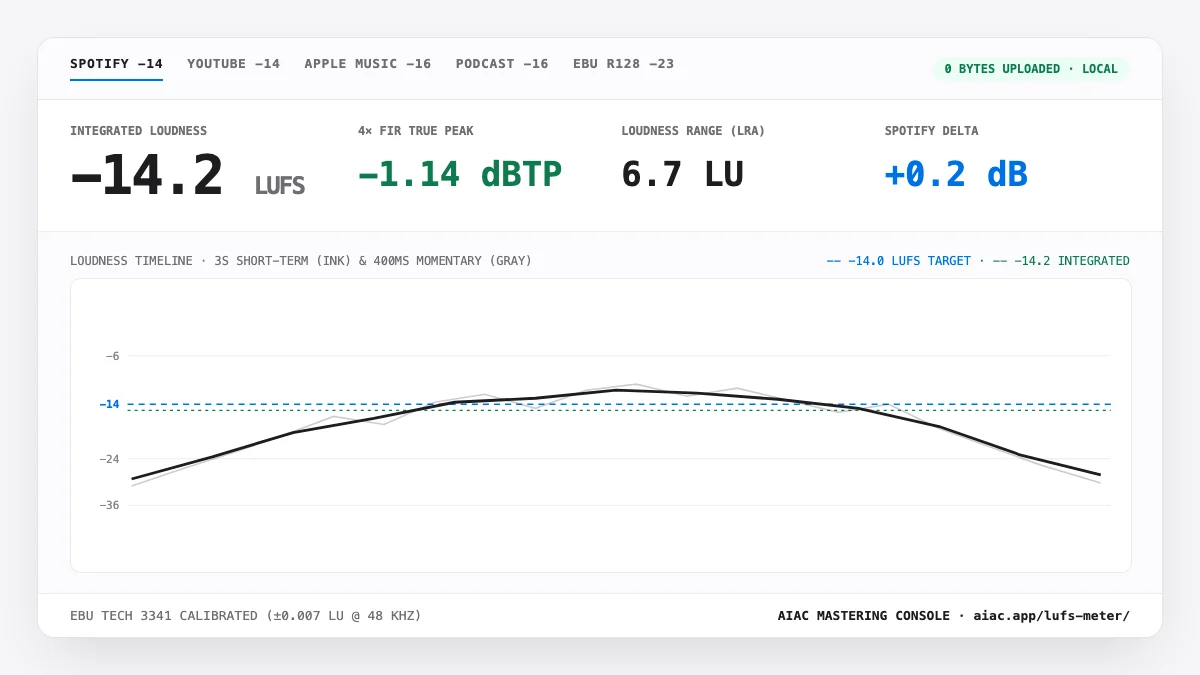
Spotify normalizes playback to -14.0 LUFS (-1.0 dBTP ceiling). Tracks mastered hotter than -14 LUFS are turned down automatically.
| Platform Target | Spec (LUFS / Peak) | Delta vs Target | Status |
|---|
Need clean gain matching without opening a DAW? Adjust loudness locally with soft-clip protection.
Open Volume Booster →0 uploads — everything runs in your browser tab. Audio decoding, K-weighting, gating, and 48-tap FIR True Peak execute locally in RAM. See DevTools & EBU Tech 3341 proof ↓
ACT I · ACOUSTIC SIGNAL CHAIN
How ITU-R BS.1770-4 Loudness Works
Simple peak meters only report the loudest single digital sample—ignoring how human ears weight bass versus presence frequencies. Broadcast and streaming platforms instead rely on LUFS (Loudness Units relative to Full Scale) defined by ITU-R BS.1770-4 and EBU R128.
Every channel passes through a sample-rate-adaptive two-stage K-weighting filter (+4 dB high-frequency acoustic shelf at 1682 Hz modeling head diffraction, followed by a 38 Hz RLB high-pass filter), then feeds 400 ms windows with 75% overlap and dual gating at -70 LUFS absolute and -10 LU relative so quiet room tone never drags down your integrated loudness.
L_K = -0.691 + 10 · log₁₀( Σ Gᵢ · zᵢ )
400 ms blocks · 100 ms hop · -70 LUFS absolute gate · -10 LU relative gate · 48-tap 4× FIR True Peak
ACT II · LOUDNESS SPECTRUM & DYNAMIC PROFILES
Streaming & Broadcast Loudness Scale
Every distribution platform targets a distinct point on the loudness scale. Click any dynamic profile below to load its target directly into the mastering console above.
ACT III · WHY STANDARD PEAK METERS FAIL
Why Peak Meters Miss Inter-Sample True Peak Clipping
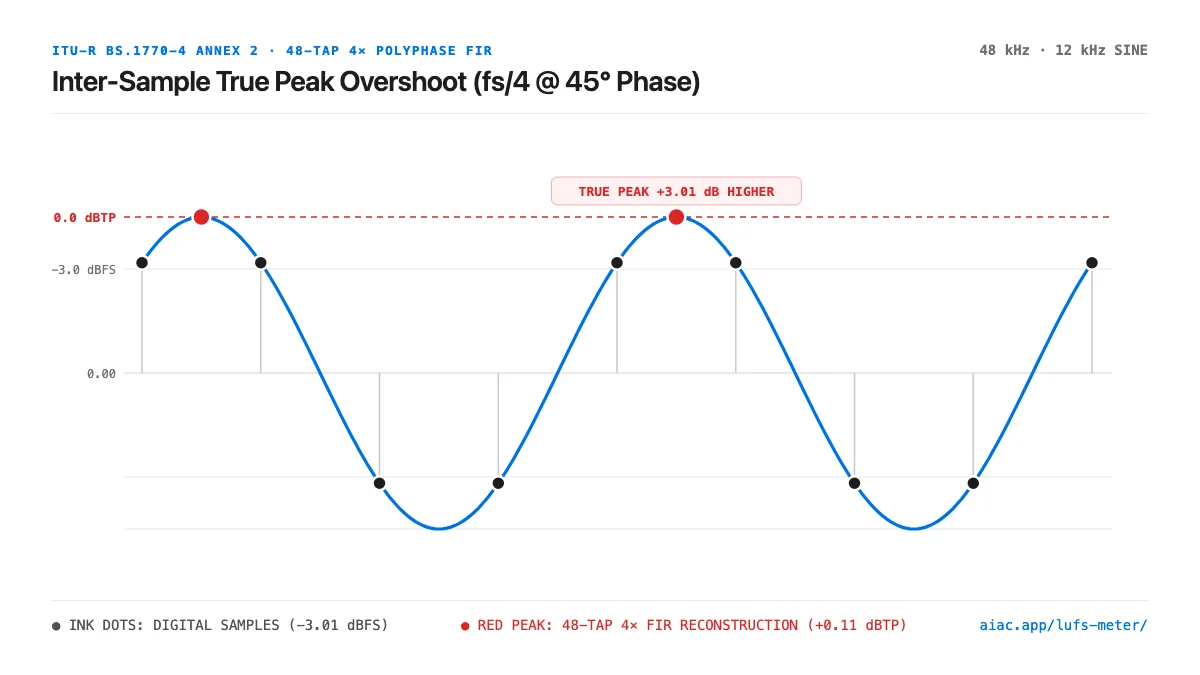
A WAV file whose highest digital sample reads -0.3 dBFS can still clip harshly on Spotify, Apple Music, or consumer DACs. When high-frequency transients land symmetrically between sample instants (such as a 12 kHz wave at 45° phase), the reconstructed analog curve overshoots the digital samples by up to +3.01 dB.
Cheap web meters either skip True Peak altogether or use 4-point cubic splines that under-report fs/4 overshoots by ~2 dB. AIAC executes a 48-tap 4× oversampled polyphase FIR filter (ITU-R BS.1770-4 Annex 2) locally in JavaScript, catching inter-sample clipping within +0.11 dBTP.
INTERACTIVE PLATFORM TARGET INDEX
Select any delivery destination below to jump back to the mastering console and evaluate your audio against its exact LUFS and True Peak spec:
ACT IV · CALIBRATION PROOF & PRIVACY AUDIT
EBU Tech 3341 Calibration & Platform Reference
AIAC's shared loudness engine (/pro-tools/dsp-core.mjs) runs identical JavaScript code in your browser and in our automated Node calibration test suite. Expand the exact specification drawers below whenever you need raw engineering tolerances.
±0.011 LU Across 44.1–96 kHz
Verified automatically against EBU Tech 3341 steady-state tones (-22.993 LUFS on -23.0 target, err +0.007 LU) and 48-tap 4× FIR inter-sample peaks (+0.108 dBTP).
Verify 0 Bytes in DevTools
Open Chrome DevTools → Network → Fetch/XHR before dropping audio: 0 audio bytes leave your tab. Enforces form-action 'none' and works completely offline once loaded.
Browser RAM Decoding
Decodes full WAV, FLAC, MP3, M4A, OGG & MP4 audio in client memory. Ideal for songs, videos, and 1-hour podcasts; multi-hour 96 kHz studio reels benefit from native desktop meters.
| Reference Test Signal | Expected Spec | AIAC Measured | Error vs Spec |
|---|---|---|---|
| EBU Tech 3341 Test 1 — 1 kHz Stereo Sine (48 kHz) | -23.000 LUFS (±0.1 LU) | -22.993 LUFS | +0.007 LU |
| EBU Tech 3341 Test 2 — 1 kHz Stereo Sine (48 kHz) | -33.000 LUFS (±0.1 LU) | -32.993 LUFS | +0.007 LU |
| Spotify Target Reference — 1 kHz Stereo (44.1 kHz) | -14.000 LUFS (±0.1 LU) | -13.991 LUFS | +0.009 LU |
| Hi-Res Apple Music / Podcast — 1 kHz Stereo (96 kHz) | -16.000 LUFS (±0.1 LU) | -16.011 LUFS | -0.011 LU |
| Dual Relative Gate (-23 LUFS + -40 LUFS Quiet Passage) | -23.0 LUFS (-10 LU gate) | -23.123 LUFS | -0.123 LU |
| 4× Polyphase FIR True Peak — fs/4 (12 kHz @ 45°; sample -3.01 dBFS) | 0.000 dBTP (±0.2 dB) | +0.108 dBTP | +0.108 dB |
| 4× Polyphase FIR True Peak — fs/8 (6 kHz @ 22.5°; sample -0.69 dBFS) | 0.000 dBTP (±0.2 dB) | +0.077 dBTP | +0.077 dB |
| Platform / Standard | Target Integrated LUFS | Max True Peak | Normalization Behavior |
|---|---|---|---|
| Spotify (Normal) | -14.0 LUFS | -1.0 dBTP (-2 dBTP for hot masters) | Tracks louder than -14 LUFS are turned down to match target |
| YouTube | -14.0 LUFS | -1.0 dBTP | Attenuates uploads above -14 LUFS; leaves quieter uploads untouched |
| Apple Music (Sound Check) | -16.0 LUFS | -1.0 dBTP | Normalizes playback around -16 LUFS while preserving album dynamics |
| Apple Podcasts / Stereo Podcast | -16.0 LUFS (±1 LU) | -1.0 dBTP | Consistent dialogue comfort across headphones and car stereos |
| Mono Spoken Podcast | -19.0 LUFS (±1 LU) | -1.0 dBTP | Optimal speech headroom for single-channel interview feeds |
| Tidal / Amazon Music | -14.0 LUFS | -1.0 to -2.0 dBTP | Applies track/album gain reduction above -14 LUFS |
| EBU R128 (EU Broadcast) | -23.0 LUFS (±0.5 LU) | -1.0 dBTP | Strict broadcast QC compliance for television and cinema |
| ATSC A/85 (US Broadcast) | -24.0 LKFS (±2 LU) | -2.0 dBTP | CALM Act compliant US broadcast dialogue loudness target |
Verifiable Zero-Upload Privacy & Mastering Headroom
Unreleased masters, client stems, and embargoed podcasts should never sit on an anonymous upload server just to read six loudness numbers. AIAC decodes your track via AudioContext.decodeAudioData and exports optional PNG loudness certificates locally through HTML5 Canvas—zero network transfer, zero account sign-up, and zero watermarks.
Practical Mastering & Podcast QC Workflows
Hitting -14 LUFS or -16 LUFS does not mean squashing dynamics flat. Aim for a Loudness Range (LRA) of 5–9 LU for modern pop and podcasts, or 8–14 LU for acoustic and cinematic arrangements. Always leave at least -1.0 dBTP headroom so Spotify Ogg Vorbis and Apple AAC transcoding stay distortion-free. Need quick local gain matching without opening a DAW? Send your track straight to our Online Audio Volume Booster, or inspect lossless integrity in the Online Fake-FLAC Checker.
ACT V · QUESTIONS & STUDIO INDEX
Frequently Asked Questions
What is LUFS and why does Spotify use -14 LUFS?
LUFS (Loudness Units relative to Full Scale) measures perceived audio loudness using human ear K-weighting instead of raw sample peaks. Spotify and YouTube normalize playback around -14 LUFS so listeners experience consistent volume across songs without reaching for the volume knob.
Does this online LUFS meter upload my audio to a server?
No. Audio decoding, two-stage ITU-R BS.1770-4 K-weighting, dual-threshold gating, 48-tap 4× FIR True Peak estimation, and PNG loudness report export all run 100% locally in your browser tab. Open Chrome DevTools → Network to confirm 0 audio bytes leave your device.
How accurate is AIAC compared to desktop meters like Youlean or NUGEN?
AIAC's shared DSP module (/pro-tools/dsp-core.mjs) is automatically calibrated against EBU Tech 3341 / ITU-R BS.1770-4 reference signals across 44.1 kHz, 48 kHz, and 96 kHz—measuring within ±0.011 LU on steady-state references (-22.993 LUFS on -23.0 target) and +0.108 dBTP on fs/4 45° inter-sample peaks.
What is the difference between Integrated, Short-Term, and Momentary LUFS?
Integrated LUFS is the dual-gated average loudness across the entire track or episode; Short-Term LUFS tracks a rolling 3-second window (ideal for checking choruses or dialogue); Momentary LUFS uses a fast 400 ms window to spot sudden loudness bursts.
Why should True Peak stay at or below -1.0 dBTP?
Inter-sample peaks can overshoot 0 dBFS during DAC reconstruction or lossy AAC/Ogg encoding on Spotify and Apple Music. Keeping True Peak at -1.0 dBTP (or -2.0 dBTP on heavily limited masters) prevents subtle high-frequency distortion.
What LUFS target should I use for podcasts versus music streaming?
Target -14.0 LUFS for Spotify and YouTube music releases, -16.0 LUFS for Apple Music and stereo podcasts (Apple Podcasts), -19.0 LUFS for mono spoken-word podcasts, and -23.0 LUFS for EBU R128 broadcast delivery.
What audio and video formats can I measure locally in the browser?
You can drop MP3, WAV, FLAC, M4A/AAC, OGG, WebM, MOV, and MP4 video files directly into the precision console. Any format supported by your browser's native Web Audio decoder is analyzed in RAM with zero upload.
Companion Browser-Local Audio Tools
- Online Fake-FLAC Checker Audit raw FLAC headers and 80-slice FFT spectrograms (16/18/20 kHz cutoff check) with zero upload. →
- SoundCraft Online DAW Pure Rust WebAssembly multitrack studio with 25+ DSP plugins, strict zero-external-host CSP, and lossless bounce. →
- Online Audio Volume Booster Raise quiet recordings up to 500% or trim hot masters locally with soft-clip protection. →
- All AIAC Browser Audio Tools Browse the complete zero-upload studio index, persona workflow matrix, and tool comparisons. →